
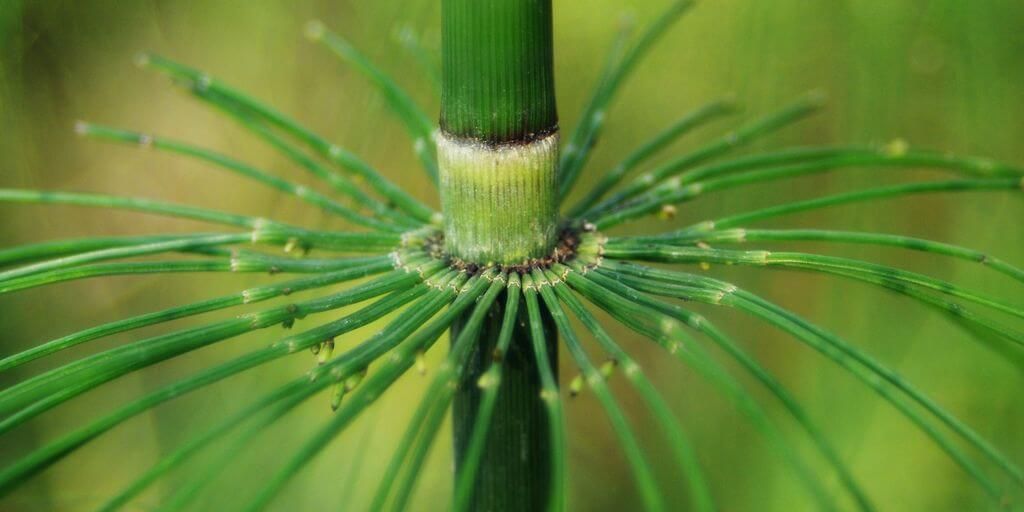
Horsetail, also known as Equisetum arvense, is a genus of perennial plants in the Equisetaceae family. These plants are characterized by their unique appearance, with hollow, jointed stems resembling the tail of a horse, hence the name “horsetail.” Horsetail plants reproduce through spores rather than seeds and have a long evolutionary history, dating back millions of years.
Horsetail is an Ancient Plant
Horsetail is a descendant of Ancient plants that grew as tall as trees during the Carboniferous Period of prehistoric times, and members of this family gave rise to many of our coal deposits.
Horsetail is a member of the Equisetaceae family; the sole survivor of a line of plants going back three hundred million years! The name “Horsetail”, often used for the entire group, arose because the branched species somewhat resemble a horse’s tail.
Traditional Uses of Horsetail
Horsetail has a rich history of traditional medicinal use, particularly in herbal medicine practices around the world. It is valued for its high silica content, which is believed to contribute to its potential health benefits. Horsetail is commonly used to support urinary tract health, promote healthy skin, hair, and nails, and as a general tonic for overall wellness.
In addition to its medicinal uses, horsetail has also been used for various other purposes throughout history. It has been utilized in traditional crafts and for its abrasive properties in polishing and cleaning. Horsetail is also sometimes cultivated as an ornamental plant in gardens and landscaping for its unique appearance and texture.
Health Benefits of Horsetail
Since being recommended by the Roman physician Galen, several cultures have employed Horsetail as a folk remedy for kidney and bladder troubles, arthritis, bleeding ulcers and tuberculosis. The Chinese use it to cool fevers and as a remedy for eye inflammations such as conjunctivitis and corneal disorders, dysentery, flu, swellings and hemorrhoids.
Horsetail is also recommended for anemia and general debility. It has also been used to treat deep-seated lung damage such as tuberculosis or emphysema.
Horsetail may be taken internally to stop bleeding from ulcers or curb heavy menstrual bleeding. It may also be used as a gargle and mouth rinse for sore throat and bleeding gums or mouth ulcers.
Horsetail for Lead Detox
Recent research in Russia has apparently demonstrated that horsetail is effective in removing lead accumulations in the body.
Silica in Horsetail
Because of its content of silica, this plant is recommended when it is necessary for the body to repair bony tissues. Silica helps to fix calcium, so that the body can store more quantity of this mineral and then use it to repair bones, collagen and other body tissues. Horsetail can therefore be useful for osteoporosis.
Horsetail’s silica content encourages the absorption and use of calcium by the body and also helps to guard against fatty deposits in the arteries. Its influence on lipid metabolism leads to potential benefit for cardiovascular problems.
It has been established that administration of silicic acid causes leukocytosis (a temporary increase in white blood cells).
Astringent Properties of Horsetail
Horsetail is an astringent herb and has a diuretic action. It has an affinity for the urinary tract where it can be used to sooth inflammation, haemorrhaging, cystic ulceration, ulcers, cystitis and to treat infections. It is considered a specific remedy in cases of inflammation or benign enlargement of the prostate gland and is also used to quicken the removal of kidney stones.
The toning and astringent action of Horsetail make it of value in the treatment of incontinence and bed-wetting in children. It may be applied to such conditions as urethritis or cystitis with haematuria (blood cells in the urine), reducing haemorrhage and healing wounds thanks to the high silica content.
This local astringent and anti-hemorrhagic effect explains the application of horsetail to such conditions as bleeding from the mouth, nose and vagina, its use to check diarrhoea, dysentery and bleeding from the bowel, and for slow-healing wounds, chilblains and conjunctivitis.
Diuretic Properties of Horsetail
Horsetail constitutes one of the most diuretic species in all the plants. That is to say that it possesses a great capacity to eliminate water from the body, in such a point to increase urination up to 30% more than what is habitual.
This fact makes that its scientific name Equisetum arvense generally appears in the composition of most of products that habitually are sold to reduce weight. This property is due to the action of several components, among which it is necessary to highlight equisetin and potassium, but there are another ones that also take part such as calcium, magnesium, ascorbic acid (Vitamin C) and caffeic acid.
As a diuretic it is particularly suited to metabolic or hormonal oedema during the menopause. The diuretic action is thought to be due partly to the flavonoids and saponins. Equisetum is restorative to damaged pulmonary tissue after pulmonary tuberculosis and other lung disease, as the silicic acid is said to stabilise the scar tissue.
External Uses of Horsetail
Externally, Horsetail is a vulnerary and may be applied as a compress to fractures and sprains, wounds, sores and skin problems. A vulnerary is a substance, typically an herb or plant extract, that is used to promote wound healing or to soothe and protect damaged or injured skin. Vulneraries may be applied topically as poultices, creams, or ointments to wounds, cuts, bruises, burns, or other skin injuries to help accelerate the healing process and reduce inflammation and discomfort.
Shopping
| Visit the new SHOPPING page for a wide selection of great products! |
Always take care when taking herbs and Read Our Disclaimer.
Horsetail Herb Notes / Side Effects
While horsetail can offer potential health benefits, it’s essential to use it cautiously and under the guidance of a healthcare professional. Some species of horsetail contain toxic compounds that can be harmful if ingested in large quantities, and excessive consumption should be avoided.
Horsetail contains equisetic acid, which is thought to be identical to aconitic acid. This substance is a heart and nerve sedative that is a poison when taken in abnormally high doses.
Additionally, horsetail supplements may interact with certain medications, so it’s important to consult with a healthcare provider before using them, especially if you have underlying health conditions or are taking prescription medications.
Latin Name
Equisetum arvense
Common Names
Horsetail, snake grass, puzzlegrass At Quyroughi, Atkuyrugu, Bottle-brush, Chieh Hsu Ts’Ao, Cola De Caballo, Corn Horsetail, Dutch rushes, Equiseto Menor, Field Horsetail, Horsetail, Horsetail Rush, Kilkah Asb, Mare’s tail, Paddock-pipes, Pewterwort, Prele, Scouring Rush, Shave-grass, Sugina, Thanab Al Khail, Vara De Oro, Wen Ching, candock (for branching individuals), snake grass or scouring-rush (for unbranched or sparsely branched plants).
Properties of Horsetail
Anodyne, anti-haemorrhagic, anti-septic, astringent, cardiac, carminative, diaphoretic, diuretic, emmenagogue, galactagogue, hemostatic, nervine, vulnerary.
Horsetail is Indicated for:
Anaemia, arthritis, bed-wetting, cardiovascular problems, chilblains, conjunctivitis, cystitis with haematuria, emphysema, enuresis, general debility, gout, heavy menstrual bleeding, incontinence, kidney and bladder troubles, kidney stones (quickens their removal), oedema (menopausal), osteoporosis, prostate problems and disease, tuberculosis, ulcers, urethritis, urinary tract infections.
Leave a Reply